As I’ve been resting and letting my mind wander post-surgery, a surprising clarity surfaced — the kind that only appears when life slows down enough for old memories to speak.
My sister had been staying with me for a few days after I left hospital. One afternoon, while we were reminiscing about her early teaching days in the 1980s, my mind drifted back to my own classroom in the late 1990s.
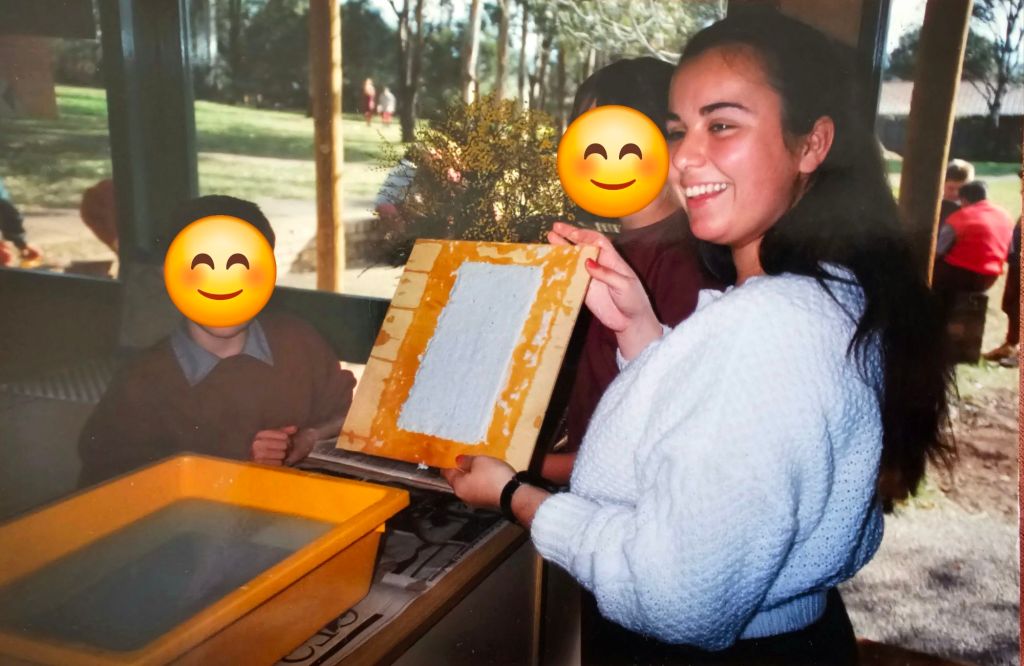
Throwback to the 1990s — teaching ‘literacy through the arts’ by beginning with vision, creation, and hands-on curiosity. Here, we were making handmade paper as the starting point for a storytelling project.
Back then, the traditional approach to literacy was very clear:
Write the story first. Only when it’s finished can you create the picture.
It was a system that left many primary-aged students feeling like they were constantly failing.
If they didn’t finish the writing, they stayed in at lunch.
Missed out on activities.
Fell behind.
Lost confidence.
And negative behaviours followed — not because they were “difficult,” but because the process didn’t work for how they thought, expressed, or imagined.
From the beginning, I knew something wasn’t right.
At the same time, I was studying Gardner’s Theory of Multiple Intelligences and Bloom’s Taxonomy as part of my continuing professional development, specialising in Teaching Literacy Through the Arts. And a question kept emerging among like-minded peers:
What if the problem wasn’t the students — but the sequence?
So I did something very unconventional for the era.
I flipped the approach.
Instead of forcing writing first, I invited students to begin with creation:
- drawing
- painting
- collaging
- sculpting with playdough or pipe cleaners
- even making up a little song
Create the end product first — the story world, the feeling, the character, the scene.
And once they had something tangible and meaningful in front of them, we used it as an anchor to:
- brainstorm
- scaffold
- draft
- revise
- publish
Everything changed.
Behaviour improved.
Engagement skyrocketed.
The joy came back.
And literacy — the thing they had been “failing” at — suddenly felt possible.

I didn’t realise it then, but I was teaching them something far bigger than writing:
I was teaching them visioning.
Possibility thinking.
An early form of hope.
Fast-forward to this week — lying quietly, recovering, letting my thoughts drift without agenda — the memory resurfaced with a clarity that almost startled me.
Because without planning it, I still work this way today.
I start with the vision, self-reflection, and clarity — the image, the shape, the spark.
And then I build the scaffolding that turns that spark into something real.
It’s the same process that underpinned my teaching, long before I had language for theories like Hope Action Theory.
And it’s the same process that now underpins the frameworks, resources, and creative approaches I use in my work today.
Hope begins with clarity and imagination.
With seeing something before you know how to build it.
With creating the picture first — and trusting that the words, the meaning, the steps will follow.
It turns out the approach I developed in the 1990s didn’t disappear when I left the classroom.
It simply grew up with me.

If you flipped the sequence and let vision lead again, what set-aside possibility might be ready to ignite something new in you?
 Jenn Barfield - Holistic Clarity Coaching