Using Automotive Thinking to Navigate Change, Clarity and Direction
Not just about careers, but how we make sense of change.
What if making sense of change didn’t start with pressure…
but with something as simple as a spark of curiosity?
What if, instead of trying to “figure everything out,”
you could begin with something far more familiar:
Not job titles.
Not rigid plans.
But systems. Signals. Adjustments.
Because for many people — especially those who think in practical, hands-on, or technical ways, clarity doesn’t come from more thinking.
It comes from seeing and doing things differently.
A Different Starting Point
I translate complex ideas into language people already understand,
sparking curiosity and unlocking clarity and hope in a creative, non-threatening way.
A short glimpse during Melbourne Motor Show 2026, of how sparking curiosity in familiar environments can open up new ways of thinking about change and direction.
Because when language fits the person, something shifts.
What once felt overwhelming becomes something you can explore.
What felt stuck begins to move.
What felt uncertain becomes something you can work with.
Sometimes, clarity doesn’t come from sitting down to “figure things out”…
but from engaging with something familiar, in a completely different way.
When Language Becomes the Bridge, Not the Barrier
Many approaches to change, career development, and decision-making rely on language that can feel abstract or disconnected from how people actually think.
But when we shift the language, using something familiar like automotive systems, themes and imagery, a different kind of conversation opens up.
A “problem” becomes a signal
Feeling stuck becomes a system worth exploring
Uncertainty becomes part of the process, not something to avoid
This approach is founded on Hope Action Theory, a framework focused on building and sustaining actionable hope through reflection, clarity, goal setting, and adaptive action.
It is brought to life through creative engagement strategies such as metaphor, imagery, and experiential prompts, using a hands-on approach and a sense of playfulness that is engaging that invites exploration while maintaining depth.
Rather than teaching the theory and competences directly, it is translated into something more intuitive.
Something people can see, feel, and engage with.
What This Looks Like in Practice
This isn’t about adding more information.
It’s about making sense of what’s already there, in a way that feels accessible, practical, and real.
This approach is experienced through hands-on exploration and a sense of playfulness, creating space for people to think differently without pressure.
Here are a few ways this approach comes to life:
Clarity Engine Check
A guided experience to explore what’s happening beneath the surface.
- What’s running smoothly?
- What’s misfiring?
- What needs attention?
Driven by Curiosity
Experiential prompts and guided exploration, from motor shows to everyday environments, that invite people to notice:
- What draws their attention
- Where skill and precision show up
- What signals change or possibility
- What feels unexpectedly meaningful
Diagnostic & Dashboard Prompts
Short, tactile prompts designed to:
- Spark reflection without overthinking
- Create psychological distance from pressure
- Encourage new ways of seeing situations
Drive Your Career & Liminal Drive Card Decks
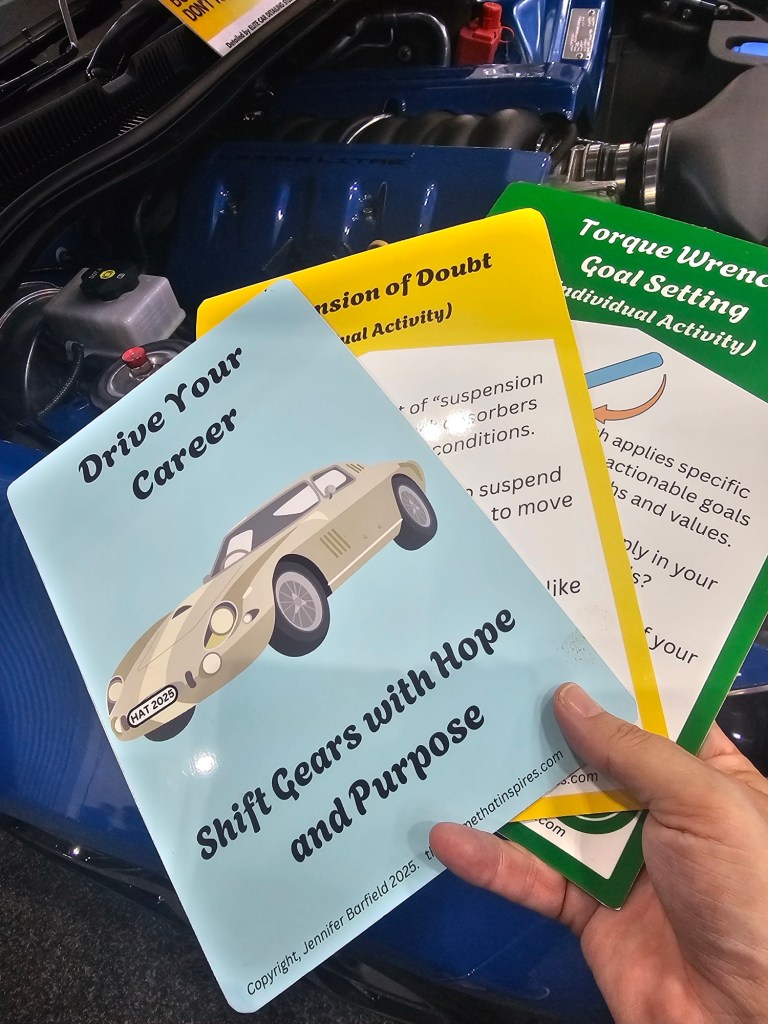
Visual tools using automotive imagery to support:
- moments of pause
- recognising signals
- navigating transitions
- re-engaging with direction
From Curiosity to Clarity in Practice
Curiosity is not soft.
In high-pressure environments, it stretches thinking.
When someone who thinks in systems, diagnostics, and adjustment is faced with uncertainty, the question shifts.
Not “What should I do next?”
But “What can be understood, adjusted, or tested?”
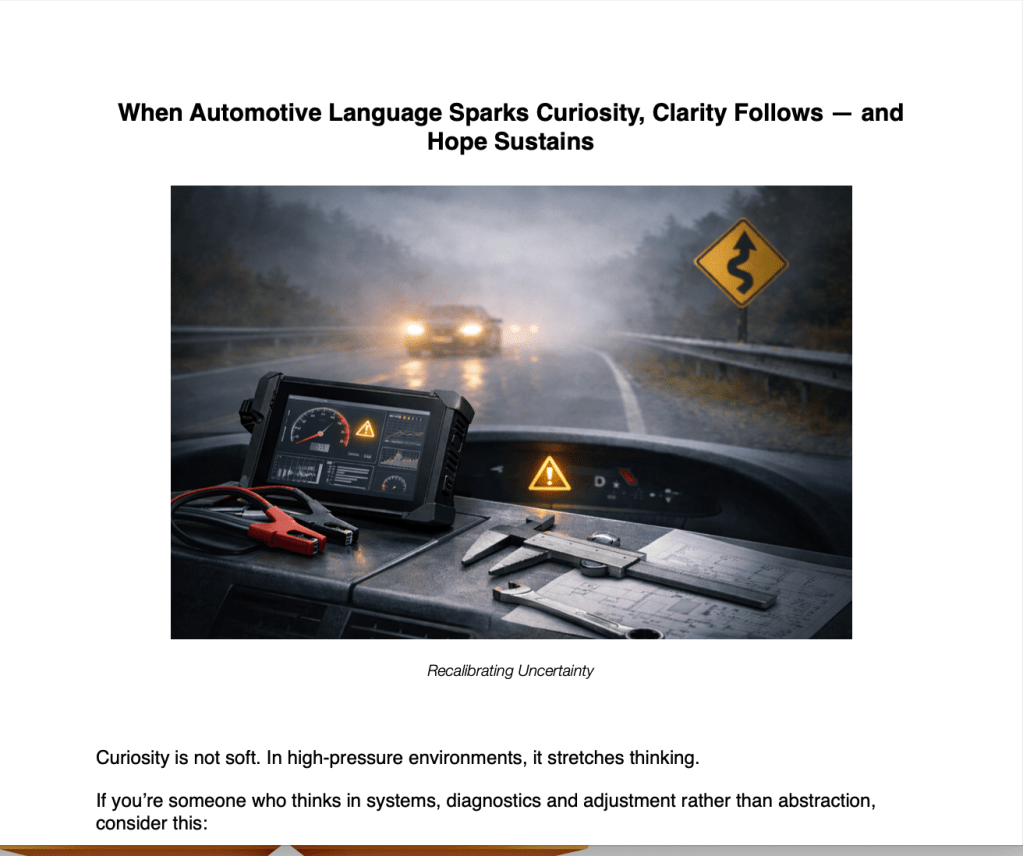
In one example, a veteran navigating medical uncertainty described it as “driving in the fog,” with no clear control of the route or destination.
Recalibrating Uncertainty — Case Study
This case study shows how automotive thinking, grounded in Hope Action Theory and brought to life through creative engagement strategies, supports clarity and sustainable hope.
It uses a hands-on approach and a sense of playfulness to make complex situations more navigable.
Who This Resonates With
This approach resonates with people who may not always connect with “traditional” methods and frameworks.
Including:
- Veterans navigating transition to civilian life
- Individuals feeling stuck, uncertain, or at a crossroads
- Automotive enthusiasts and technically-minded thinkers
- Teams and organisations seeking more engaging ways to explore change
It’s particularly powerful where identity, uncertainty, and direction intersect.
Why It Matters
When people are navigating change, they don’t just need answers.
They need:
- space to think differently
- language that makes sense to them
- a way to move forward without added pressure
By combining creative engagement strategies with structured frameworks like Hope Action Theory, this approach creates a bridge between:
- reflection and action
- uncertainty and possibility
- thinking and doing
And ultimately, it helps people build and sustain hope, in a way that feels grounded, practical, and their own.
Explore Further
If you’re curious about how this approach shows up in different contexts:
🔍 Understanding the Approach
Developed over five+ years working with veterans, and shaped during travels across the UK and Germany in 2024, Drive Your Career turns language into a bridge — helping people get curious, make sense of uncertainty, find clarity, and move forward with hope.
- The Origins of Drive Your Career: When Language Becomes the Bridge
👉Read the blog
🧠 Reflections & Insights
- Self-Care is Like Servicing Your Car — Essential, Not Optional
A simple automotive metaphor that explores how small, consistent acts of self-care support resilience, clarity, and long-term momentum. 👉 Read the blog - Curiosity, Connection, and Sustainable Hope at the Australian Automotive Aftermarket Expo
Reflections from the Australian Automotive Aftermarket Expo (AAAE) exploring curiosity, automotive culture, experiential learning, and how automotive language can help people build clarity and sustainable hope. 👉 Read the blog
Exploring ideas around clarity, curiosity, and sustainable momentum — in ways that connect to everyday life.
🛠 In Practice
Recalibrating Uncertainty — Feature Case Study (Veteran Transition)
A practical example of how automotive thinking, creative engagement strategies, and a hands-on approach with a sense of playfulness support clarity and sustainable hope.
👉 Read the full article and download the case study
This reflection was first shared on LinkedIn as part of an ongoing exploration of curiosity, clarity, and automotive thinking in practice.
If you’d like to see the original post and conversations:
🔗 View the original LinkedIn post
A Gentle Invitation
If this way of thinking resonates,
there are a number of ways we can explore it further.
Through workshops, conversations, or collaborative projects,
this approach can be adapted across different settings — from individuals navigating change to teams and organisations exploring new ways of thinking.
Sometimes, all it takes is a small shift in how we see things…
to begin moving in a completely different direction.
 Jenn Barfield - Holistic Clarity Coaching